
Enterprise AI Governance: The Foundation for Trusted Innovation
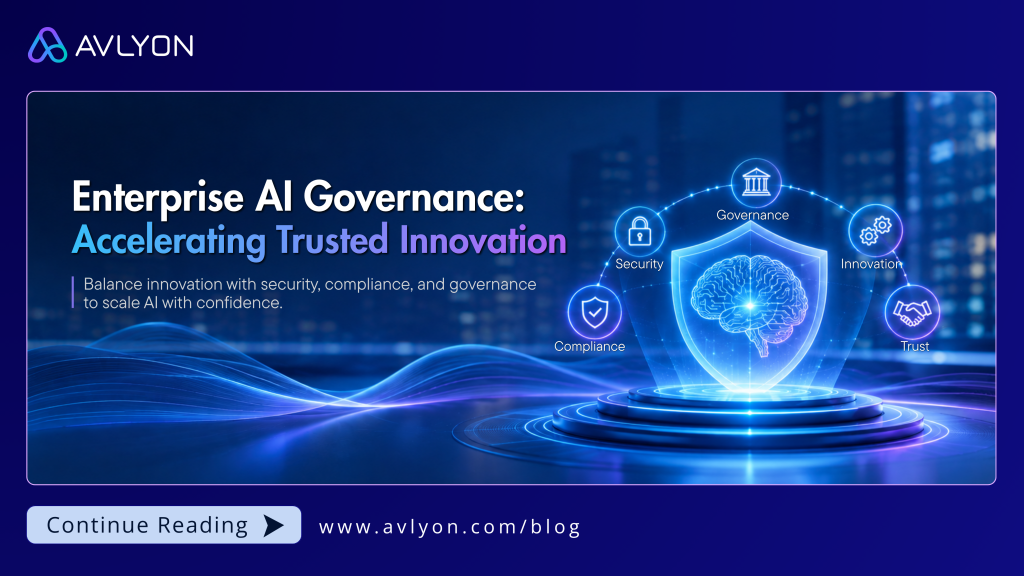
Artificial Intelligence | Enterprise Strategy AI adoption is easy to start and hard to scale. Governance is what separates the two. Every enterprise wants AI. Few are ready to govern it. AI has moved past the pilot stage. Organizations are using it to build products, serve customers, automate operations, and support decisions that used to require a full team. The problem is not adoption. It is what happens after adoption. Different departments pick different tools. Sensitive data gets shared without a clear policy behind it. Compliance requirements shift faster than internal processes can keep up. Security teams inherit risks nobody scoped for. Leadership loses visibility into what is actually running across the business. At that point, the real question stops being “how do we adopt AI” and becomes “how do we govern what we already have.” Where most companies get stuck Governance has a bad reputation. People hear the word and picture approval chains and slow-moving committees. In practice, the companies that scale AI fastest are usually the ones with the clearest governance, not the least. Clear rules about what data can go where, who owns a decision, and how a system gets monitored remove the guesswork that otherwise stalls every new AI initiative at the “can we actually do this” stage. Governance does not replace speed. It is what makes speed sustainable. What scaling without governance looks like The failures rarely show up on day one. They show up once AI use spreads past the first team that adopted it. A sales team feeds customer data into a tool nobody in security reviewed. A finance team automates a decision process with no audit trail behind it. Three business units each license their own AI vendor, and six months later nobody can say which system holds what data, or under what agreement. Then something breaks. A model makes a decision that cannot be explained to a regulator. A vendor changes its data handling terms and the business finds out after the fact. An audit asks who approved a specific AI use case, and the answer is nobody, because no one owned that decision to begin with. None of this looks like a single dramatic failure. It looks like a slow accumulation of small gaps, each one reasonable on its own, that eventually add up to a governance problem the business cannot answer for. By the time leadership notices, the fix is rarely a quick patch. It usually means pulling back systems that are already embedded in daily operations, which costs far more than building the governance from the start. What governance actually requires Strong AI governance is not a security checklist bolted onto existing systems. It has to work across five areas at once: Strategic alignment. Every AI initiative should map to a measurable business outcome, not just a capability someone wanted to try. Data governance. Data quality, privacy, ownership, and access controls need to hold up through the entire AI lifecycle, not just at intake. Security and risk management. AI systems introduce operational, regulatory, and cybersecurity exposure that did not exist in the old stack. That exposure needs an owner. Responsible AI. Transparency, accountability, and human oversight are not optional extras. They are what keep an AI system defensible when something goes wrong. Continuous monitoring. AI performance drifts. Governance has to include a mechanism for catching that drift and correcting course, not just a one-time signoff. Miss any one of these and the other four stop mattering. A company can have airtight data governance and still get blindsided by a compliance shift nobody was monitoring for. Trusted innovation starts with governance The organizations that win with AI over the next decade will not be the ones that moved fastest. They will be the ones that built a foundation strong enough to keep moving. At Avlyon, we help organizations turn AI governance from a compliance obligation into a business capability, one that supports faster decisions instead of slowing them down. Want to know where your organization stands? Get in touch with Avlyon for a governance readiness conversation.
Why Businesses Lose Customers After Hours and How AI Is Changing That
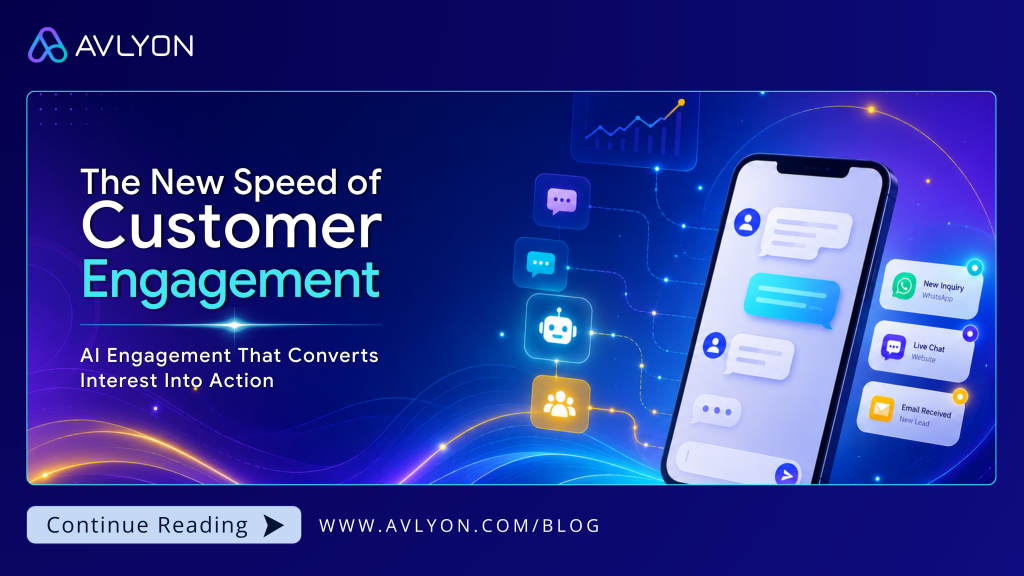
How AI engagement is helping businesses respond faster and convert more customers There is a moment most businesses know too well. A potential customer reaches out late in the evening, interested, ready to ask questions, and possibly ready to buy. No one responds. By the next morning, they have already moved on to a competitor who replied faster. The opportunity disappears quietly. Not because the product was weak or the pricing was wrong, but because the business was unavailable at the moment the customer was ready to engage. For many organizations, this is not a sales problem. It is a responsiveness problem. And in today’s digital environment, responsiveness has become one of the most important competitive advantages a business can have. The Attention Window Is Smaller Than Ever Customer attention moves quickly. Studies consistently show that response time directly affects lead conversion. A delay of even an hour can significantly reduce the likelihood of turning interest into action. Yet many businesses still rely entirely on human availability to manage customer engagement. The result is a gap between when customers reach out and when businesses are able to respond. That gap is becoming increasingly expensive. Today’s customers compare providers, explore alternatives, and make decisions faster than ever before. A customer who does not receive a timely response often does not wait. They simply move on. Businesses that fail to close the availability gap are not just slower. They become invisible at the exact moment customers are ready to engage. What Customers Expect Today Customer expectations have fundamentally changed. People now interact daily with digital experiences that provide instant updates, real-time answers, and personalized recommendations. Whether booking a service, ordering food, tracking deliveries, or exploring financial products, customers expect fast and relevant interactions regardless of the time of day. Those expectations do not disappear after business hours. Someone browsing at 11 PM expects the same level of responsiveness as someone reaching out at 11 AM. For businesses relying solely on human teams, this creates a structural limitation that becomes harder to scale as demand grows. Across industries, organizations gaining momentum are the ones finding ways to stay responsive throughout the customer journey, not only during working hours. How AI Is Reshaping Customer Engagement Artificial intelligence is making it possible for businesses to stay responsive without relying on large teams working around the clock. Modern AI engagement systems can now hold meaningful conversations with customers across platforms like WhatsApp, SMS, websites, and other messaging channels. They can answer questions instantly, qualify leads, guide customer inquiries, and connect high-value prospects to the right teams in real time. What separates today’s AI engagement from the chatbots businesses experimented with years ago is the quality of the interaction. Earlier systems often felt rigid and scripted. Modern AI tools can understand context, recognize customer intent, adapt responses dynamically, and deliver interactions that feel more natural and relevant. The goal is not to replace human relationships. It is to remove the friction that prevents those relationships from starting. Smarter Lead Qualification One of the biggest challenges for sales teams is identifying which inquiries deserve immediate attention. AI engagement systems can analyze conversation patterns, customer behavior, and engagement signals to prioritize leads automatically. Instead of manually filtering inquiries, teams can focus their time on prospects who show genuine buying intent. This reduces wasted effort while improving response speed where it matters most. Personalization at Scale Personalized engagement has always been valuable, but traditionally it has been difficult to scale consistently. AI changes that equation. Businesses can now tailor messaging based on customer preferences, behaviors, interaction history, and timing across thousands of conversations simultaneously. Customers receive interactions that feel relevant and timely without businesses having to expand support teams proportionally. As customer expectations continue to rise, personalization is quickly becoming a baseline expectation rather than a differentiator. Meeting Customers Across Multiple Channels Customers no longer engage through a single platform. Some prefer WhatsApp. Others respond better through SMS, websites, email, or social platforms. Businesses that force customers into one communication channel often create unnecessary friction. AI-powered engagement systems help organizations maintain a consistent presence across multiple channels at the same time, allowing customers to interact through the platforms they already use comfortably. This flexibility is becoming increasingly important as customer behavior continues to fragment across digital ecosystems. Industries Already Seeing the Impact The shift toward AI-powered engagement is already reshaping how businesses operate across multiple industries. Real Estate Property inquiries happen at all hours, often from buyers comparing multiple listings simultaneously. AI engagement allows agencies to respond immediately, answer common questions, qualify buyers, and schedule appointments without delays. Health and Wellness Clinics, gyms, and wellness providers manage large volumes of appointment requests, reminders, and customer follow-ups. Intelligent automation improves responsiveness while reducing administrative pressure on frontline teams. Restaurants and Hospitality Reservation inquiries, menu questions, and promotional campaigns require consistency and speed. AI engagement helps hospitality businesses maintain responsive customer interactions without overextending staff resources. Education Educational institutions often manage high inquiry volumes during enrollment periods. AI systems can guide prospective students, answer frequently asked questions, and identify inquiries requiring personal attention. Banking and Financial Services In industries where trust and responsiveness are critical, AI engagement supports faster communication, smoother onboarding experiences, and more accessible customer support while maintaining consistency and accuracy. What Effective AI Engagement Actually Looks Like Not every AI engagement system creates a better customer experience. Consistency With Brand Voice The best AI interactions feel like a natural extension of the business itself. Businesses should be able to define tone, messaging style, and communication guidelines so automated interactions reinforce brand identity rather than weaken it. Knowing When Human Support Matters AI works best when it recognizes its own limitations. Well-designed systems know when conversations require human judgment and can escalate interactions smoothly without frustrating customers. The transition should feel seamless rather than disruptive. Integration With Existing Workflows AI engagement should not operate in isolation. Systems that integrate with CRM platforms, sales tools, and operational workflows create a
How AI Is Reshaping Software Delivery: What Engineering Teams Need to Know
Separating real capability from the noise and what it takes to make AI work in modern delivery teams Artificial intelligence is changing how software gets built. It is changing how developers write code, how QA teams find defects, how project managers track risk, and how engineering leaders make architecture decisions. Most technology organisations already know this. The harder question is what to actually do about it, and in what order. The teams getting the most value from AI in software delivery are not the ones moving fastest. They are the ones that strengthened their engineering foundations first, then introduced AI where it compounded those strengths. The teams that skipped that step are discovering that AI amplifies weak processes just as readily as strong ones. This article covers where AI is genuinely delivering value in engineering today, where the capability is heading, where the risks are underappreciated, and what a disciplined adoption approach looks like for organisations that want to move forward without locking themselves into a cycle of rework and readjustment. The Shift That Is Already Happening Every major tooling shift in software engineering has forced teams to retrain, restructure, and rethink how they work. Version control, agile delivery, cloud infrastructure, DevOps practices: each one changed the economics of software development. AI-assisted engineering is the next shift, and it is compressing the adoption cycle faster than most previous ones. GitHub’s research suggests developers using AI coding assistants complete tasks significantly faster, with some scenarios showing a 55 percent improvement in task completion speed. More importantly, developers report spending less time on boilerplate, repetitive logic, and context switching, which frees capacity for the higher-value thinking that actually determines software quality. The gains are real. They are also conditional. Teams with clear code standards, disciplined review processes, and strong test coverage absorb AI tooling well. Teams without those foundations find that AI generates plausible-looking output faster than their review process can catch what is wrong with it. The tool does not create the discipline. The discipline has to come first. Start With First Principles, Not Tool Selection Most AI adoption inside engineering teams begins in the wrong place. Teams see what competitors are using, read what vendors are recommending, and make decisions by analogy. That approach tends to produce tooling that fits someone else’s problem rather than their own. First principles thinking asks a different set of questions before any tool is selected. What does excellent software delivery actually require in this organisation? Where does the delivery process break down today, and why? Which of those breakdowns are caused by a lack of information, which by a lack of speed, and which by a lack of discipline? Only once those questions are answered clearly does it make sense to ask which AI capabilities map to those specific gaps. This distinction matters more in AI adoption than in almost any previous tooling decision, for two reasons. First, the capability landscape is evolving fast enough that committing too early to a specific workflow or toolchain risks locking the team into an approach that becomes obsolete within months. Second, AI tools are persuasive. They produce output that looks correct. Teams without a clear first-principles picture of what good looks like will find it difficult to evaluate whether AI is genuinely improving their delivery or simply changing the shape of the problem. The organisations that apply first principles thinking to AI adoption end up asking better questions at every stage: not just which tool to use, but what capability the team actually needs, what the adoption risk looks like at their current maturity level, and what success looks like in measurable terms. That rigour is what separates a genuine improvement in delivery capability from a well-intentioned experiment that creates more noise than value. Where AI Is Adding Genuine Value in Delivery The public conversation about AI in software engineering tends to focus on code generation and autocomplete, as if those represent the ceiling of what the technology can do. They do not. The capability has moved considerably further, and understanding the full landscape matters for any team making adoption decisions today. Developer assistance and autonomous coding agents What began as autocomplete has evolved into systems capable of reasoning across entire codebases, proposing multi-file changes, writing and running tests against their own output, and iterating based on feedback. Autonomous coding agents can now take a clearly specified task and execute it end to end with minimal human input. This is a significant shift from a productivity tool to something closer to a junior contributor. The practical implication is that the quality of the specification matters as much as the quality of the prompt. Garbage in, garbage out has not changed. What has changed is the speed at which garbage gets produced. Automated code review and static analysis AI-integrated review tools surface potential issues, flag security vulnerabilities, suggest refactoring opportunities, and identify style inconsistencies before a human reviewer sees the pull request. More advanced implementations can reason about architectural intent, not just syntax, and flag changes that are technically correct but structurally problematic. This does not replace code review. It elevates the level at which human review adds value. Intelligent test generation and self-healing pipelines Beyond generating unit tests from existing code, newer capabilities include test suites that identify their own coverage gaps, detect flaky tests, and in some implementations update themselves when application behaviour changes in expected ways. For teams inheriting legacy codebases with low coverage, this changes the economics of technical debt remediation significantly. Documentation, knowledge capture, and onboarding AI tooling can generate inline documentation, summarise complex modules, map system dependencies, and produce onboarding material directly from existing code and conversation history. For organisations where key knowledge is concentrated in a small number of people, this has business continuity value that extends well beyond delivery efficiency. Incident analysis and autonomous debugging AI systems can now analyse logs, correlate error patterns across distributed systems, propose likely root causes, and in some cases suggest or apply fixes
AI Feature Rollouts Made Smarter: Deploy Safely and Scale with Confidence
AI Feature Rollouts Made Smarter: Deploy Safely and Scale with Confidence Artificial intelligence is no longer confined to research labs. Today, AI and machine learning are embedded in everyday products, powering personalization, automation, and predictive capabilities. For businesses that want to stay competitive, deploying AI features is no longer optional. But while the opportunities are significant, the risks are equally high. Poorly managed AI rollouts can disrupt performance, erode user trust, and even raise ethical concerns. According to Gartner, only 54% of AI projects make it from pilot to production, and less than half of those deliver the expected business value. The challenge is not simply building smart models. It is deploying them with processes that are safe, scalable, and responsible. Why Safe AI Deployment Matters Unlike traditional software, AI is dynamic. A model that looks accurate in testing may perform very differently in production as data shifts, user behavior evolves, or hidden biases appear. Without safeguards in place, businesses risk releasing unstable or unfair features at scale. To achieve reliable AI deployment, teams must address four critical questions: How do we validate models before they impact real users? What risks can emerge from biased training data? How do we maintain accuracy as data changes over time? When and how should features be rolled back if performance declines? Recent surveys reveal that more than 65% of organizations experimenting with AI experience rollout delays caused by poor testing and monitoring. Structured deployment approaches are the key to overcoming these setbacks. Building Stability Before Scaling Successful AI feature rollouts begin in controlled environments. Instead of exposing all users to a new model immediately, teams should adopt incremental testing. Shadow deployments, where AI models run silently in the background, allow predictions to be compared against real outcomes without affecting user experience. Similarly, phased A/B testing ensures that features demonstrate measurable improvements before being scaled further. At Avlyon, our engineering teams guide clients through phased rollouts with robust monitoring. This approach minimizes risk while building confidence that AI features are ready to scale responsibly. Continuous Monitoring and Feedback Loops At Avlyon, our product engineering teams work with clients to define key events early in the product lifecycle to ensure accurate measurement and smarter decisions. Build Feedback Loops Into the Feature Lifecycle Safe AI deployment does not end at launch. Models must be continuously monitored to ensure they adapt to changing data and remain aligned with business goals. Monitoring should extend beyond accuracy to cover latency, drift detection, error rates, and fairness gaps. Cloud-native tools such as AWS SageMaker Model Monitor and Azure Machine Learning Monitoring provide automated oversight of model performance. Leading teams combine these tools with human-in-the-loop validation to catch subtle errors and respond quickly. This combination of automation and human judgment ensures that AI rollouts remain both reliable and user-centric. Versioning and Governance for Reliability AI feature rollouts are only as strong as the versioning practices behind them. Tracking model versions, datasets, and parameters makes it possible to reproduce results, roll back safely, and prove compliance with industry regulations. Platforms like MLflow and Weights & Biases simplify model versioning and experiment tracking. According to Gartner’s 2024 AI Operations report, organizations using structured versioning are 40% less likely to experience critical downtime during deployment. Version control is more than a technical safeguard. For AI features impacting sensitive areas such as credit approvals, healthcare decisions, or fraud detection, governance and traceability are essential foundations of accountability. Embedding Ethical Guardrails Responsible AI deployment is not just about technical performance. It also requires ethical oversight. Fairness, transparency, and privacy must be part of every AI rollout plan. Frameworks such as Google’s Responsible AI Toolkit and IBM AI Fairness 360 provide methods to detect and mitigate bias before models reach production. Forward-looking organizations treat ethics as a design principle, not just a compliance checkbox. Publishing transparency notes, performing regular audits, and empowering users with data control fosters long-term trust and credibility. Real-World Impact of Smarter Rollouts When AI rollouts are planned with care, the business impact is measurable: A retail app used phased deployment to refine its recommendation engine, boosting conversions by 25 percent without disrupting existing user flows. A SaaS provider rolled out an AI-driven support bot in stages, starting with low-risk queries. Continuous monitoring revealed category bias, which was corrected before full release. A fintech platform applied strict version control for fraud detection models. When a new model flagged legitimate transactions, the team rolled back instantly, preserving both user trust and system reliability. These examples show how disciplined AI rollout strategies transform experimental features into dependable growth drivers. Final Thought Deploying AI features is not only about integrating intelligence into products. It is about doing so responsibly, with processes that protect users, safeguard trust, and deliver sustainable value. By combining stability, monitoring, versioning, and ethical oversight, organizations can scale AI confidently while reducing risks. At Avlyon, we specialize in AI feature rollouts that are technically sound, ethically guided, and built to scale. If you are ready to deploy AI features with confidence and unlock real business value, our team is ready to help.