
Enterprise AI Governance: The Foundation for Trusted Innovation
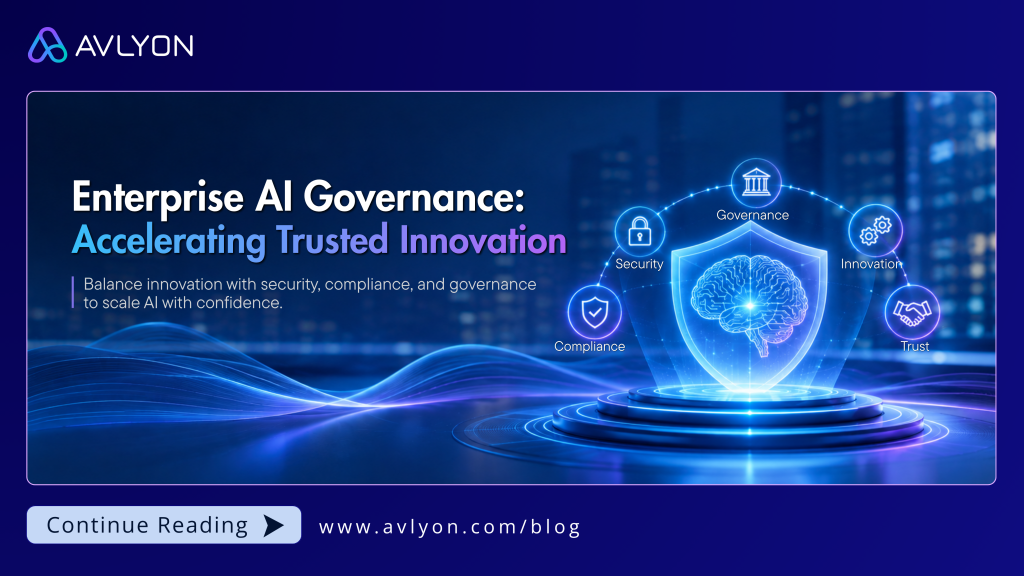
Artificial Intelligence | Enterprise Strategy AI adoption is easy to start and hard to scale. Governance is what separates the two. Every enterprise wants AI. Few are ready to govern it. AI has moved past the pilot stage. Organizations are using it to build products, serve customers, automate operations, and support decisions that used to require a full team. The problem is not adoption. It is what happens after adoption. Different departments pick different tools. Sensitive data gets shared without a clear policy behind it. Compliance requirements shift faster than internal processes can keep up. Security teams inherit risks nobody scoped for. Leadership loses visibility into what is actually running across the business. At that point, the real question stops being “how do we adopt AI” and becomes “how do we govern what we already have.” Where most companies get stuck Governance has a bad reputation. People hear the word and picture approval chains and slow-moving committees. In practice, the companies that scale AI fastest are usually the ones with the clearest governance, not the least. Clear rules about what data can go where, who owns a decision, and how a system gets monitored remove the guesswork that otherwise stalls every new AI initiative at the “can we actually do this” stage. Governance does not replace speed. It is what makes speed sustainable. What scaling without governance looks like The failures rarely show up on day one. They show up once AI use spreads past the first team that adopted it. A sales team feeds customer data into a tool nobody in security reviewed. A finance team automates a decision process with no audit trail behind it. Three business units each license their own AI vendor, and six months later nobody can say which system holds what data, or under what agreement. Then something breaks. A model makes a decision that cannot be explained to a regulator. A vendor changes its data handling terms and the business finds out after the fact. An audit asks who approved a specific AI use case, and the answer is nobody, because no one owned that decision to begin with. None of this looks like a single dramatic failure. It looks like a slow accumulation of small gaps, each one reasonable on its own, that eventually add up to a governance problem the business cannot answer for. By the time leadership notices, the fix is rarely a quick patch. It usually means pulling back systems that are already embedded in daily operations, which costs far more than building the governance from the start. What governance actually requires Strong AI governance is not a security checklist bolted onto existing systems. It has to work across five areas at once: Strategic alignment. Every AI initiative should map to a measurable business outcome, not just a capability someone wanted to try. Data governance. Data quality, privacy, ownership, and access controls need to hold up through the entire AI lifecycle, not just at intake. Security and risk management. AI systems introduce operational, regulatory, and cybersecurity exposure that did not exist in the old stack. That exposure needs an owner. Responsible AI. Transparency, accountability, and human oversight are not optional extras. They are what keep an AI system defensible when something goes wrong. Continuous monitoring. AI performance drifts. Governance has to include a mechanism for catching that drift and correcting course, not just a one-time signoff. Miss any one of these and the other four stop mattering. A company can have airtight data governance and still get blindsided by a compliance shift nobody was monitoring for. Trusted innovation starts with governance The organizations that win with AI over the next decade will not be the ones that moved fastest. They will be the ones that built a foundation strong enough to keep moving. At Avlyon, we help organizations turn AI governance from a compliance obligation into a business capability, one that supports faster decisions instead of slowing them down. Want to know where your organization stands? Get in touch with Avlyon for a governance readiness conversation.
Growth and Innovation Through Strategic Partner Programs

Building Value and Expanding Markets Through the Power of Collaborative Innovation In today’s technology-driven world, success is rarely achieved alone. The companies that thrive are those that leverage strategic partnerships to reach new markets, co-create innovative solutions, and deliver measurable value to clients. Well-structured partner programs are a powerful way to connect organizations, maximize expertise, and accelerate growth. Strategic partnerships go beyond traditional vendor relationships. They are designed to create mutual business value, where both partners grow stronger together by combining industry knowledge, customer access, and technology capabilities. Why Strategic Partner Programs Matter in B2B Technology and Beyond For B2B technology companies, strategic partner programs offer clear advantages such as faster scaling, market expansion, and access to complementary expertise. However, the value extends equally to partner companies, including non tech organizations operating in industries such as finance, manufacturing, retail, logistics, healthcare, and professional services. Partnering with a technology provider enables these companies to strengthen their offerings, modernize operations, and deliver more value to their customers without building complex technology capabilities internally. This shared model allows each partner to focus on what they do best, while benefiting from the strengths of the other. Industry research shows that indirect channels often contribute a significant portion of enterprise technology revenue, highlighting the growing importance of partnerships as a core business growth strategy. Expanding Market Reach and New Revenue Opportunities for Partners One of the strongest benefits of a strategic partner program is expanded market access for both sides. For technology companies, partners provide trusted access to new customers and industries. For partner companies, especially non tech firms, collaboration creates new revenue streams by enabling them to offer digital, data-driven, or software-enabled solutions alongside their existing services. Consulting firms, industry specialists, and channel partners can enhance their value proposition by introducing modern technology solutions to their clients, increasing deal sizes and strengthening long-term client relationships. This mutual access accelerates sales cycles, improves conversion rates, and supports sustainable revenue growth. Co Creation That Strengthens Partner Offerings Co creation is a central pillar of successful partner ecosystems. By combining technology expertise with deep industry knowledge, partners can jointly design solutions that are more relevant, practical, and impactful for end customers. For non tech partners, this means the ability to deliver technology-enabled solutions without the cost and risk of building internal engineering teams. For technology providers, it ensures solutions are grounded in real-world business challenges and market needs. Co-developed solutions often reach the market 30 to 50 percent faster, giving both partners a competitive advantage and enabling them to respond quickly to evolving customer demands. Delivering Stronger Outcomes for Shared Customers Today’s customers expect integrated, outcome-focused solutions rather than standalone products or services. Strategic partnerships allow companies to deliver end-to-end solutions that combine technology, advisory expertise, and industry insight. For partner companies, this translates into improved customer satisfaction, stronger differentiation, and increased trust. They are able to offer complete solutions that solve business problems more effectively, while relying on a trusted technology partner for implementation and innovation. Organizations that leverage partner ecosystems consistently report higher customer retention and long-term client value. Optimizing Costs and Reducing Risk for Partners Strategic partner programs also deliver financial and operational benefits to partner companies. By sharing resources, knowledge, and infrastructure, partners can reduce upfront investment and operational risk. Non tech companies gain access to skilled technology teams, proven platforms, and scalable solutions without the cost of building and maintaining internal systems. This approach allows them to experiment, innovate, and grow with lower risk and greater flexibility. Companies engaged in structured partner programs often experience 15 to 25 percent cost savings when expanding services or entering new markets, making partnerships an efficient growth model. Partner Profiles That Drive Mutual Value A strong partner ecosystem welcomes diverse partner profiles, each benefiting in different ways: Channel PartnersGain new digital offerings to sell into their existing networks while increasing revenue potential. Consulting FirmsEnhance advisory services by integrating technology solutions that drive measurable business outcomes. Technology ProvidersExpand solution capabilities through complementary offerings and shared innovation. Referral PartnersMonetize trusted relationships by introducing solutions that deliver real client value. StartupsAccelerate growth and credibility by co-creating solutions with established partners. Each profile gains access to new opportunities while contributing unique strengths to the ecosystem. Partnership Tiers That Support Partner Growth Structured partner programs typically offer tiers that align incentives with contribution and commitment: Associate PartnerAn entry point offering referral benefits, onboarding support, and foundational resources. Growth PartnerAccess to revenue sharing, co-marketing initiatives, and collaborative solution delivery. Strategic PartnerDeep collaboration with joint planning, priority engagement, and long-term strategic growth alignment. These tiers provide partners with a clear growth path and increasing value as collaboration deepens. Key Stats at a Glance Final Thoughts Strong partner ecosystems create value that goes far beyond technology. They empower companies across industries to grow faster, innovate smarter, and deliver better outcomes to their customers. For organizations looking to expand their capabilities, unlock new revenue streams, or strengthen their offerings through collaboration, strategic partnerships offer a proven path forward. To explore how your organization can benefit and join a structured, win win partner ecosystem, learn more about the Avlyon Strategic Partner Program here: https://avlyon.com/partner-program/
Engineering for Resilient Software in the Era of Rising Cyber Threats

Engineering for Resilient Software in the Era of Rising Cyber Threats Why Resilience Is the New Benchmark for Software In today’s digital economy, software powers everything from business operations to customer experiences. Yet, the same technology that drives growth has also become a prime target for cyber threats. According to Check Point Research, global cyberattacks increased by 38% in 2024, with many incidents tied to vulnerabilities in cloud systems and software supply chains. This growing threat landscape has made resilience an essential part of software engineering. Building resilient software is no longer about adding protection at the end of development. It is about designing systems that can adapt, recover, and continue to perform reliably even under attack or failure. Security as a Foundation, Not a Feature Traditional software development often treated security as a final step before launch. That approach no longer works. Modern engineering teams integrate protection from the start, following a secure-by-design mindset. Key practices include: Threat modeling to identify possible attack paths before coding begins. Automated code scanning and reviews to detect vulnerabilities early. Zero Trust frameworks that verify every access request. Ongoing patching and dependency management to prevent outdated code risks. Scalable Architecture for Reliable Performance Resilience is built on flexibility. Cloud-native architectures that use microservices and containers allow applications to adapt to dynamic conditions without downtime. When each component operates independently, issues can be isolated quickly, minimizing impact on the entire system. This distributed design enables faster recovery, automatic scaling, and stronger reliability. Gartner predicts that by 2026, more than 85% of organizations will rely on cloud-native architecture to improve resilience and reduce downtime. At Avlyon, our engineers design modular systems with container orchestration to ensure performance and stability under pressure. Each project is tailored to handle growth, security, and performance without compromise. Testing Beyond Functionality Testing for functionality is no longer enough. Today, development teams test for endurance, failure recovery, and resistance to attacks. Common resilience testing techniques include: Penetration testing to expose exploitable weaknesses. Chaos engineering to simulate real-world disruptions. Load and performance testing to assess system stability under high demand. According to IBM’s 2024 Cost of a Data Breach Report, organizations that regularly conduct testing and simulation save an average of USD 1.5 million per breach compared to those that do not. Testing for resilience ensures systems are prepared for unpredictable conditions and builds user trust through reliability. Continuous Monitoring and Rapid Response Maintaining resilience requires constant awareness. Continuous monitoring enables teams to detect irregular activity before it becomes a threat. Modern observability tools combine analytics and automation to track: Response times and latency Error rates and service availability Unauthorized access attempts System performance trends When integrated with automated alerts and self-healing workflows, these systems help identify and resolve problems instantly. This proactive approach turns monitoring into a source of protection and operational intelligence. The Human Factor in Digital Resilience Technology is only as strong as the people behind it. Building resilient software also requires a culture of security awareness. Within a DevSecOps framework, developers, engineers, and operations teams share responsibility for risk management and response. Training and collaboration ensure that everyone understands the potential impact of design and deployment choices. A McKinsey study revealed that 70% of cybersecurity incidents are caused by human error, misconfiguration, or lack of awareness. This shows that investing in people is just as important as investing in technology. At Avlyon, we emphasize continuous learning and collaboration across teams to ensure every member contributes to maintaining trust and resilience. The Future of Predictive Resilience The next stage of resilient software is not just reacting to threats but predicting them. AI-driven monitoring tools now detect anomalies and prevent issues before they escalate. By integrating predictive analytics into DevOps workflows, organizations can detect unusual activity patterns, automate responses, and maintain consistent uptime. This predictive resilience allows systems to improve continuously while minimizing business disruption. Resilience has evolved into a strategic advantage that strengthens brand reputation, customer trust, and long-term performance. Final Thought Engineering resilient software means building systems that adapt to change, recover from failure, and operate with confidence. At Avlyon, we believe in trust, talent, and thrive. These values guide how we design technology that performs reliably, scales efficiently, and stands strong in the face of emerging challenges. Our teams help clients create software that is not only functional but also future-ready. To learn how Avlyon can help your business strengthen its digital foundation, visit www.avlyon.com and connect with our experts.