
Enterprise AI Governance: The Foundation for Trusted Innovation
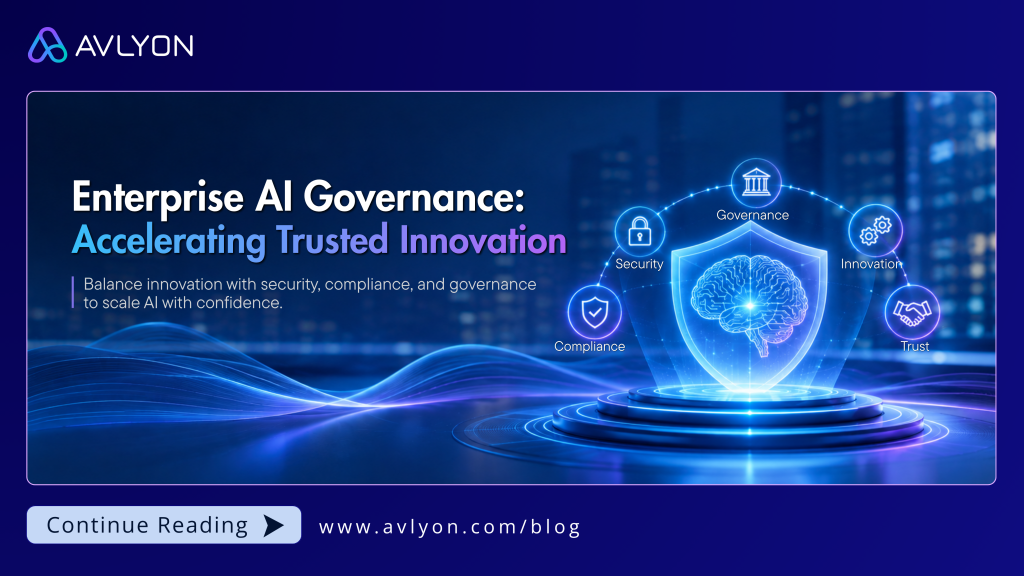
Artificial Intelligence | Enterprise Strategy AI adoption is easy to start and hard to scale. Governance is what separates the two. Every enterprise wants AI. Few are ready to govern it. AI has moved past the pilot stage. Organizations are using it to build products, serve customers, automate operations, and support decisions that used to require a full team. The problem is not adoption. It is what happens after adoption. Different departments pick different tools. Sensitive data gets shared without a clear policy behind it. Compliance requirements shift faster than internal processes can keep up. Security teams inherit risks nobody scoped for. Leadership loses visibility into what is actually running across the business. At that point, the real question stops being “how do we adopt AI” and becomes “how do we govern what we already have.” Where most companies get stuck Governance has a bad reputation. People hear the word and picture approval chains and slow-moving committees. In practice, the companies that scale AI fastest are usually the ones with the clearest governance, not the least. Clear rules about what data can go where, who owns a decision, and how a system gets monitored remove the guesswork that otherwise stalls every new AI initiative at the “can we actually do this” stage. Governance does not replace speed. It is what makes speed sustainable. What scaling without governance looks like The failures rarely show up on day one. They show up once AI use spreads past the first team that adopted it. A sales team feeds customer data into a tool nobody in security reviewed. A finance team automates a decision process with no audit trail behind it. Three business units each license their own AI vendor, and six months later nobody can say which system holds what data, or under what agreement. Then something breaks. A model makes a decision that cannot be explained to a regulator. A vendor changes its data handling terms and the business finds out after the fact. An audit asks who approved a specific AI use case, and the answer is nobody, because no one owned that decision to begin with. None of this looks like a single dramatic failure. It looks like a slow accumulation of small gaps, each one reasonable on its own, that eventually add up to a governance problem the business cannot answer for. By the time leadership notices, the fix is rarely a quick patch. It usually means pulling back systems that are already embedded in daily operations, which costs far more than building the governance from the start. What governance actually requires Strong AI governance is not a security checklist bolted onto existing systems. It has to work across five areas at once: Strategic alignment. Every AI initiative should map to a measurable business outcome, not just a capability someone wanted to try. Data governance. Data quality, privacy, ownership, and access controls need to hold up through the entire AI lifecycle, not just at intake. Security and risk management. AI systems introduce operational, regulatory, and cybersecurity exposure that did not exist in the old stack. That exposure needs an owner. Responsible AI. Transparency, accountability, and human oversight are not optional extras. They are what keep an AI system defensible when something goes wrong. Continuous monitoring. AI performance drifts. Governance has to include a mechanism for catching that drift and correcting course, not just a one-time signoff. Miss any one of these and the other four stop mattering. A company can have airtight data governance and still get blindsided by a compliance shift nobody was monitoring for. Trusted innovation starts with governance The organizations that win with AI over the next decade will not be the ones that moved fastest. They will be the ones that built a foundation strong enough to keep moving. At Avlyon, we help organizations turn AI governance from a compliance obligation into a business capability, one that supports faster decisions instead of slowing them down. Want to know where your organization stands? Get in touch with Avlyon for a governance readiness conversation.
Corporate Treasury Automation and Why It Matters Today

Treasury teams face increasing pressure to deliver real time cash visibility and accurate reporting, yet many still depend on spreadsheets and manual workflows. Discover how modern automation transforms treasury operations and strengthens financial stability.
AI Feature Rollouts Made Smarter: Deploy Safely and Scale with Confidence
AI Feature Rollouts Made Smarter: Deploy Safely and Scale with Confidence Artificial intelligence is no longer confined to research labs. Today, AI and machine learning are embedded in everyday products, powering personalization, automation, and predictive capabilities. For businesses that want to stay competitive, deploying AI features is no longer optional. But while the opportunities are significant, the risks are equally high. Poorly managed AI rollouts can disrupt performance, erode user trust, and even raise ethical concerns. According to Gartner, only 54% of AI projects make it from pilot to production, and less than half of those deliver the expected business value. The challenge is not simply building smart models. It is deploying them with processes that are safe, scalable, and responsible. Why Safe AI Deployment Matters Unlike traditional software, AI is dynamic. A model that looks accurate in testing may perform very differently in production as data shifts, user behavior evolves, or hidden biases appear. Without safeguards in place, businesses risk releasing unstable or unfair features at scale. To achieve reliable AI deployment, teams must address four critical questions: How do we validate models before they impact real users? What risks can emerge from biased training data? How do we maintain accuracy as data changes over time? When and how should features be rolled back if performance declines? Recent surveys reveal that more than 65% of organizations experimenting with AI experience rollout delays caused by poor testing and monitoring. Structured deployment approaches are the key to overcoming these setbacks. Building Stability Before Scaling Successful AI feature rollouts begin in controlled environments. Instead of exposing all users to a new model immediately, teams should adopt incremental testing. Shadow deployments, where AI models run silently in the background, allow predictions to be compared against real outcomes without affecting user experience. Similarly, phased A/B testing ensures that features demonstrate measurable improvements before being scaled further. At Avlyon, our engineering teams guide clients through phased rollouts with robust monitoring. This approach minimizes risk while building confidence that AI features are ready to scale responsibly. Continuous Monitoring and Feedback Loops At Avlyon, our product engineering teams work with clients to define key events early in the product lifecycle to ensure accurate measurement and smarter decisions. Build Feedback Loops Into the Feature Lifecycle Safe AI deployment does not end at launch. Models must be continuously monitored to ensure they adapt to changing data and remain aligned with business goals. Monitoring should extend beyond accuracy to cover latency, drift detection, error rates, and fairness gaps. Cloud-native tools such as AWS SageMaker Model Monitor and Azure Machine Learning Monitoring provide automated oversight of model performance. Leading teams combine these tools with human-in-the-loop validation to catch subtle errors and respond quickly. This combination of automation and human judgment ensures that AI rollouts remain both reliable and user-centric. Versioning and Governance for Reliability AI feature rollouts are only as strong as the versioning practices behind them. Tracking model versions, datasets, and parameters makes it possible to reproduce results, roll back safely, and prove compliance with industry regulations. Platforms like MLflow and Weights & Biases simplify model versioning and experiment tracking. According to Gartner’s 2024 AI Operations report, organizations using structured versioning are 40% less likely to experience critical downtime during deployment. Version control is more than a technical safeguard. For AI features impacting sensitive areas such as credit approvals, healthcare decisions, or fraud detection, governance and traceability are essential foundations of accountability. Embedding Ethical Guardrails Responsible AI deployment is not just about technical performance. It also requires ethical oversight. Fairness, transparency, and privacy must be part of every AI rollout plan. Frameworks such as Google’s Responsible AI Toolkit and IBM AI Fairness 360 provide methods to detect and mitigate bias before models reach production. Forward-looking organizations treat ethics as a design principle, not just a compliance checkbox. Publishing transparency notes, performing regular audits, and empowering users with data control fosters long-term trust and credibility. Real-World Impact of Smarter Rollouts When AI rollouts are planned with care, the business impact is measurable: A retail app used phased deployment to refine its recommendation engine, boosting conversions by 25 percent without disrupting existing user flows. A SaaS provider rolled out an AI-driven support bot in stages, starting with low-risk queries. Continuous monitoring revealed category bias, which was corrected before full release. A fintech platform applied strict version control for fraud detection models. When a new model flagged legitimate transactions, the team rolled back instantly, preserving both user trust and system reliability. These examples show how disciplined AI rollout strategies transform experimental features into dependable growth drivers. Final Thought Deploying AI features is not only about integrating intelligence into products. It is about doing so responsibly, with processes that protect users, safeguard trust, and deliver sustainable value. By combining stability, monitoring, versioning, and ethical oversight, organizations can scale AI confidently while reducing risks. At Avlyon, we specialize in AI feature rollouts that are technically sound, ethically guided, and built to scale. If you are ready to deploy AI features with confidence and unlock real business value, our team is ready to help.