
The Best Engineering Partnerships Don’t End at Handover
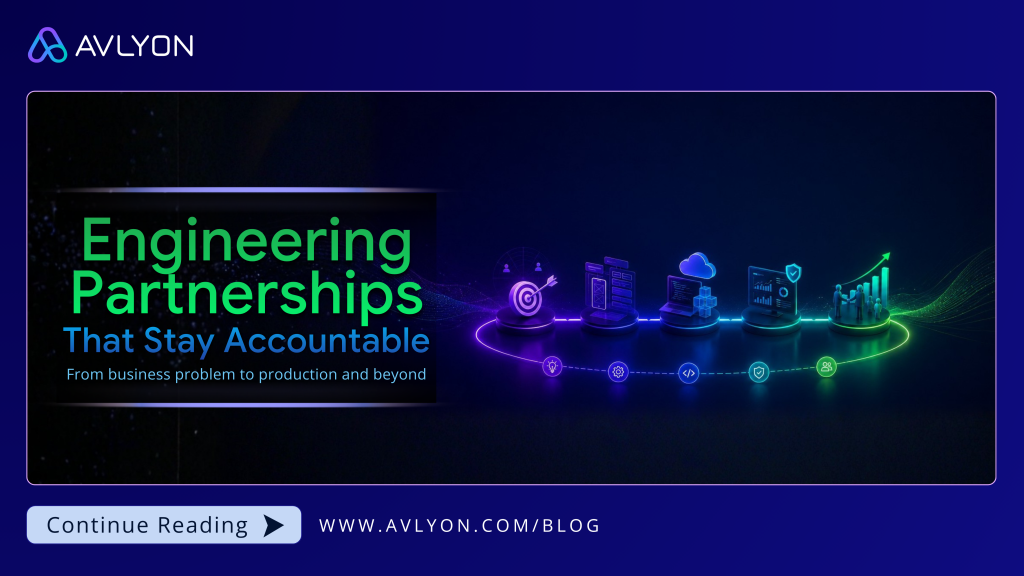
Rethinking the engineering partnership, from business problem to production and beyond. There is a pattern that most software engineering engagements follow. A client arrives with a set of requirements, an engineering partner builds against them, the product ships, and the relationship winds down until the next request comes in. This works. It has worked for years, and it will keep working for a certain kind of project. But it also leaves something on the table, for both sides. The Limits of the Requirements-and-Handover Model When engineering starts at the requirements document, it inherits every assumption baked into that document, whether or not those assumptions were ever tested against the real business problem. The engineering partner builds what was asked for. The client receives what was asked for. If the two are not quite the same thing as what the business actually needed, nobody finds out until after launch, when the cost of being wrong is highest and the least flexible to fix. There is also a quieter cost. Once the handover happens, the engineering partner’s stake in the outcome effectively ends: they deliver against spec, and what happens next, adoption, growth, revenue, becomes someone else’s problem to solve. That arrangement is clean on paper, but it is also the reason so many well-built products struggle after launch. The people who understood the system best are no longer in the room when it matters most. A Different Way to Engage There is a more strategic way to structure an engineering partnership, one that starts earlier and stays longer. It begins with the business problem itself, not the requirements document that follows it. Before any engineering decision gets made, the real question gets asked: what problem is this actually solving, and for whom. This matters because a requirements document usually describes one way of solving the problem, not the only way, and not always the best one. A partner who understands the underlying problem is in a position to propose a different approach that the client’s own requirements never considered, one that reduces cost, runs more efficiently, improves the user experience, or holds up better as things scale. Choosing the right technology from that vantage point often lowers engineering, scaling, and infrastructure costs well beyond what the original requirements accounted for. That kind of alternative rarely gets surfaced when the engagement starts at the document instead of the problem. From there, the engagement moves through a deliberate sequence. Business problem identification: Understanding what the client is actually trying to solve, and for which customer, before a single line of code gets written. MVP scoping: Defining the smallest version of the product that tests the real assumption, rather than the largest version the budget can support. Develop, deploy, and manage: Building the product, taking it to production, and operating it there, with full ownership of technical decisions, timelines, and quality, not just execution against a spec someone else wrote. Client onboarding: Carrying the product through to the people who will actually use it, so the transition from built to adopted does not fall into a gap between teams. The engineering partner owns this end to end. The client is free to focus on business development, sales, and growth, knowing the product itself is not something they need to manage day to day. This does not mean the partner stays forever, nor should it. As the product matures and stabilizes, and once the client builds sufficient engineering capability in-house to take it over, winding the engagement down is often the right call. If the client sees enough value to want the relationship to continue, that is a good outcome too. But even where the formal engagement winds down, staying available in an extended support capacity tends to benefit the client regardless, since the team that built the system remains the fastest path back to an answer if something unexpected comes up later. Why This Changes the Incentives The difference between this model and the traditional one is not really about process. It is about who has skin in the game. In a requirements-and-handover engagement, the engineering partner is measured against a spec. In an end-to-end engagement, the engineering partner is measured against whether the business problem actually got solved. That is a meaningfully different incentive, and it changes how decisions get made at every stage. Scoping gets more honest: A bloated first release helps nobody if it fails to prove anything, so the MVP stays focused on the real assumption. Production is designed in from the start: The team building it is the team taking it there, so shortcuts that only work in a demo do not make it into the build. Engagement does not stop at launch: Launch was never the finish line to begin with, so the partner stays accountable for what happens after, including the operational commitments that come with running in production. What This Requires in Practice Owning an engagement end to end is a different job from executing against a spec, and it shows up in specific, practical ways rather than just a philosophy. Architecture decisions get made with production in mind, not just the demo: Scaling, security, and failure modes get considered at design time, because the same team answers for them later. Observability and monitoring get built in, not added after something breaks: Production health should be visible from day one, so issues surface through monitoring before an end customer ever notices them, rather than the other way around. Support and maintenance commitments get built into the engagement, not negotiated afterward: When a partner is willing to back a solution with a multi-year managed and maintenance engagement, that is a concrete signal of confidence in what was built, not just a sales term. Onboarding is treated as part of delivery, not an afterthought: The people who will use the product day to day get trained and supported as part of the handover, not left to figure it out from documentation. None of this is unique to
How AI Is Reshaping Software Delivery: What Engineering Teams Need to Know
Separating real capability from the noise and what it takes to make AI work in modern delivery teams Artificial intelligence is changing how software gets built. It is changing how developers write code, how QA teams find defects, how project managers track risk, and how engineering leaders make architecture decisions. Most technology organisations already know this. The harder question is what to actually do about it, and in what order. The teams getting the most value from AI in software delivery are not the ones moving fastest. They are the ones that strengthened their engineering foundations first, then introduced AI where it compounded those strengths. The teams that skipped that step are discovering that AI amplifies weak processes just as readily as strong ones. This article covers where AI is genuinely delivering value in engineering today, where the capability is heading, where the risks are underappreciated, and what a disciplined adoption approach looks like for organisations that want to move forward without locking themselves into a cycle of rework and readjustment. The Shift That Is Already Happening Every major tooling shift in software engineering has forced teams to retrain, restructure, and rethink how they work. Version control, agile delivery, cloud infrastructure, DevOps practices: each one changed the economics of software development. AI-assisted engineering is the next shift, and it is compressing the adoption cycle faster than most previous ones. GitHub’s research suggests developers using AI coding assistants complete tasks significantly faster, with some scenarios showing a 55 percent improvement in task completion speed. More importantly, developers report spending less time on boilerplate, repetitive logic, and context switching, which frees capacity for the higher-value thinking that actually determines software quality. The gains are real. They are also conditional. Teams with clear code standards, disciplined review processes, and strong test coverage absorb AI tooling well. Teams without those foundations find that AI generates plausible-looking output faster than their review process can catch what is wrong with it. The tool does not create the discipline. The discipline has to come first. Start With First Principles, Not Tool Selection Most AI adoption inside engineering teams begins in the wrong place. Teams see what competitors are using, read what vendors are recommending, and make decisions by analogy. That approach tends to produce tooling that fits someone else’s problem rather than their own. First principles thinking asks a different set of questions before any tool is selected. What does excellent software delivery actually require in this organisation? Where does the delivery process break down today, and why? Which of those breakdowns are caused by a lack of information, which by a lack of speed, and which by a lack of discipline? Only once those questions are answered clearly does it make sense to ask which AI capabilities map to those specific gaps. This distinction matters more in AI adoption than in almost any previous tooling decision, for two reasons. First, the capability landscape is evolving fast enough that committing too early to a specific workflow or toolchain risks locking the team into an approach that becomes obsolete within months. Second, AI tools are persuasive. They produce output that looks correct. Teams without a clear first-principles picture of what good looks like will find it difficult to evaluate whether AI is genuinely improving their delivery or simply changing the shape of the problem. The organisations that apply first principles thinking to AI adoption end up asking better questions at every stage: not just which tool to use, but what capability the team actually needs, what the adoption risk looks like at their current maturity level, and what success looks like in measurable terms. That rigour is what separates a genuine improvement in delivery capability from a well-intentioned experiment that creates more noise than value. Where AI Is Adding Genuine Value in Delivery The public conversation about AI in software engineering tends to focus on code generation and autocomplete, as if those represent the ceiling of what the technology can do. They do not. The capability has moved considerably further, and understanding the full landscape matters for any team making adoption decisions today. Developer assistance and autonomous coding agents What began as autocomplete has evolved into systems capable of reasoning across entire codebases, proposing multi-file changes, writing and running tests against their own output, and iterating based on feedback. Autonomous coding agents can now take a clearly specified task and execute it end to end with minimal human input. This is a significant shift from a productivity tool to something closer to a junior contributor. The practical implication is that the quality of the specification matters as much as the quality of the prompt. Garbage in, garbage out has not changed. What has changed is the speed at which garbage gets produced. Automated code review and static analysis AI-integrated review tools surface potential issues, flag security vulnerabilities, suggest refactoring opportunities, and identify style inconsistencies before a human reviewer sees the pull request. More advanced implementations can reason about architectural intent, not just syntax, and flag changes that are technically correct but structurally problematic. This does not replace code review. It elevates the level at which human review adds value. Intelligent test generation and self-healing pipelines Beyond generating unit tests from existing code, newer capabilities include test suites that identify their own coverage gaps, detect flaky tests, and in some implementations update themselves when application behaviour changes in expected ways. For teams inheriting legacy codebases with low coverage, this changes the economics of technical debt remediation significantly. Documentation, knowledge capture, and onboarding AI tooling can generate inline documentation, summarise complex modules, map system dependencies, and produce onboarding material directly from existing code and conversation history. For organisations where key knowledge is concentrated in a small number of people, this has business continuity value that extends well beyond delivery efficiency. Incident analysis and autonomous debugging AI systems can now analyse logs, correlate error patterns across distributed systems, propose likely root causes, and in some cases suggest or apply fixes
Elevating Digital Success With User Centred UI and UX
Designing Experiences That Empower Users and Drive Business Growth